
SUNO AI Music review
 Harrij Mensinga8 min read
SUNO AI Review: The Future of Music Creation
Our Suno AI Music review. Artificial intelligence is transforming our lives and creative industries at an unprecedented pace, and music is one of the fascinating examples. AI music platforms grow day by day, and Suno AI Music has quickly risen as one of the most impressive and accessible tools available today. With simple text prompts, Suno can AI generated complete songs featuring vocals, lyrics, melodies, instrumentation, and production quality that can sometimes rival human-created demos.
But how good is Suno in use and real life? More importantly, how does an AI actually create music that sounds convincingly human?
What Is Suno AI?
Suno AI is a generative music platform allowing users to create original songs from text descriptions. No need for musical knowledge, instruments, recording equipment, or production skills, users simply describe the type of song they want. This sounds easy and it is, but to create a good sounding song it takes more then just press a button.
For example:
“Create an upbeat synth-pop song about exploring Mars with female vocals.”
Within seconds, Suno generates a complete track including:
- Instrumental arrangement
- Melody
- Vocal performance
- Lyrics
- Song structure
- Mixing and mastering elements
This dramatically lowers the barrier to music creation and enables almost anyone to produce original songs. But it sounds too easy to me and after trying out SUNO I now know what it takes beside money to create something personal. Vocals is still an issue for AI models when using your own voice and leave the AI generated voice out.
How Does AI Music Generation Actually Work?
Most people assume Suno simply “copies” music from existing artists, but the technology is far more sophisticated.
At its core, Suno uses large generative neural networks, similar in concept to the models behind ChatGPT, image generators, and modern speech synthesis systems.
Step 1: Training on Massive Music Datasets
Before Suno can create music, its AI models must be trained on enormous collections of music recordings, vocal performances, lyrics, rhythms, and musical structures.
During training, the AI learns patterns such as:
- Chord progressions
- Musical genres
- Song structures
- Vocal styles
- Instrument combinations
- Rhythmic patterns
- Emotional characteristics
The AI does not memorize entire songs in the way humans think about copying. Instead, it learns statistical relationships between musical components.
Suno doesn’t work like a DJ selecting tracks from a massive music library. It works more like a musician who has listened to millions of songs throughout life and absorbed an understanding of rhythm, melody, harmony, genre, and structure. When asked to create a new song, it uses that learned knowledge to compose something new rather than replaying existing music.
That’s a simplified explanation, but it’s very close to how modern generative music AI actually works.
Essentially, the model develops a mathematical understanding of what makes a rock song sound like rock, a jazz song sound like jazz, or a cinematic soundtrack sound cinematic. But creating her own interpretation of your promt and lyrics.
Step 2: Understanding Your Prompt
Using a prompt for Style and use your own lyrics and voice need the Advanced section of the Suno desktop interface. This option gives you a lot more control of your desired song or music. The ‘Simple’ setting is just for dummies really, it just uses press and create and ‘voila…your music is created in no time’. Ordering a pizza online takes more time and is scientific work compared to this. Useless if you want my opinion.
When you enter a prompt, Suno first uses natural language processing (NLP) to understand your instructions. This is where the AI makes up her own mind! You have in practice little control over the end result really. It takes many recordings or creations as SUNO calls it, to end up with a satisfying song. Finding the right prompt for your song will take at least 6 creations. So what you might think, well this is where the profit of SUNO is based on. You get only so many tries for your subscription. And every try takes off your availeble credits. And believe me, that goes quicker than you might think. Well we pick this subject later on!
The AI analyzes elements such as:
- Genre
- Mood
- Tempo
- Instrumentation
- Vocal style
- Theme
- Lyrics requirements
For example:
“Epic orchestral soundtrack with dramatic female vocals”
The system translates those words into musical parameters that guide the generation process. This prompt will always produce music with vocals (not songs ) however only the AI creation which may be totally different to what your personal intention is. So, here we go again: try after try setting up a prompt giving you something to work with. (Tip: search internet for good prompts. I will provide some at the bottom of this review )
Step 3: Generating Lyrics
If lyrics are required, language models create text that matches the desired theme. Read the former sentence again please IF lyrics are required, well for most pop,rock or blues songs lyrics are needed. This is where I feel SUNO still struggles. As a user you might have a great idea off a nice song. In your head you have a melody and just need the lyrics. Pen and paper or straight in the SUNO application your words find their way. What you don’t know at first is that your created lyrics are the basis for the AI rhythm and feel of
the song. Chosen rhyme of words are important. Don’t make too long sentences, it all effects the outcome.
So, again we try and try and try and our credits go quickly. SUNO also gives you the opportunity to make use of her own generated lyrics.
The AI determines:
- Verse structure
- Chorus repetition
- Rhyme schemes
- Storytelling elements
- Emotional progression
This process is similar to how AI text generators create essays or stories.
Step 4: Composing the Music
The most impressive stage is composition which works really well but this doesn’t mean it results in the melody you predicted. But apart from your expected melody it does make a song and music every time.
Again you need lots of try-outs really, but in the end you might have hit the jackpot finally. The composing is
depending on or automatic or your created style prompt. Prompts is what any AI music is based on.
The neural network generates:
- Chord progressions
- Melodies
- Harmony
- Timing
- Song structure
Instead of selecting from a library of existing music, the model predicts what musical elements should come next based on billions of learned relationships from training.
Step 5: Creating Human-Like Vocals
Modern AI music systems use advanced audio generation models capable of synthesizing realistic singing voices. This is the subject in AI music making which makes it hard voor neural engines. Voices is needed if you truly want to create a song representing and expressing yourself. SUNO lets you upload a voice sung and recorded by yourself and use it as a reference for the creation of a full selfmade song. I myself had many problems getting the AI pronounce the first words when SUNO starts creating. It sounded Russian to me instead of English and this is a well known aspect of SUNO. So many people think AI created music is sh… I feel they don’t know how much work it takes to make a song with your own composition, lyrics, vocals and tries to finally say ” Yep, this is me”! And to be honest this is where the fun begins and you might get addicted to AI music making.
The AI generates:
- Pitch
- Tone
- Pronunciation
- Timing
- Vibrato
- Expression
This is why many Suno tracks sound as if a real singer recorded them in a studio.
Step 6: Production and Mastering
The final stage adds professional polish.
The AI applies:
- Mixing
- Equalization
- Compression
- Reverb
- Stereo processing
The result is a radio-ready production that often sounds surprisingly professional.
What Makes Suno AI So Impressive?
Ease of Use
Perhaps Suno’s biggest advantage is its simplicity.
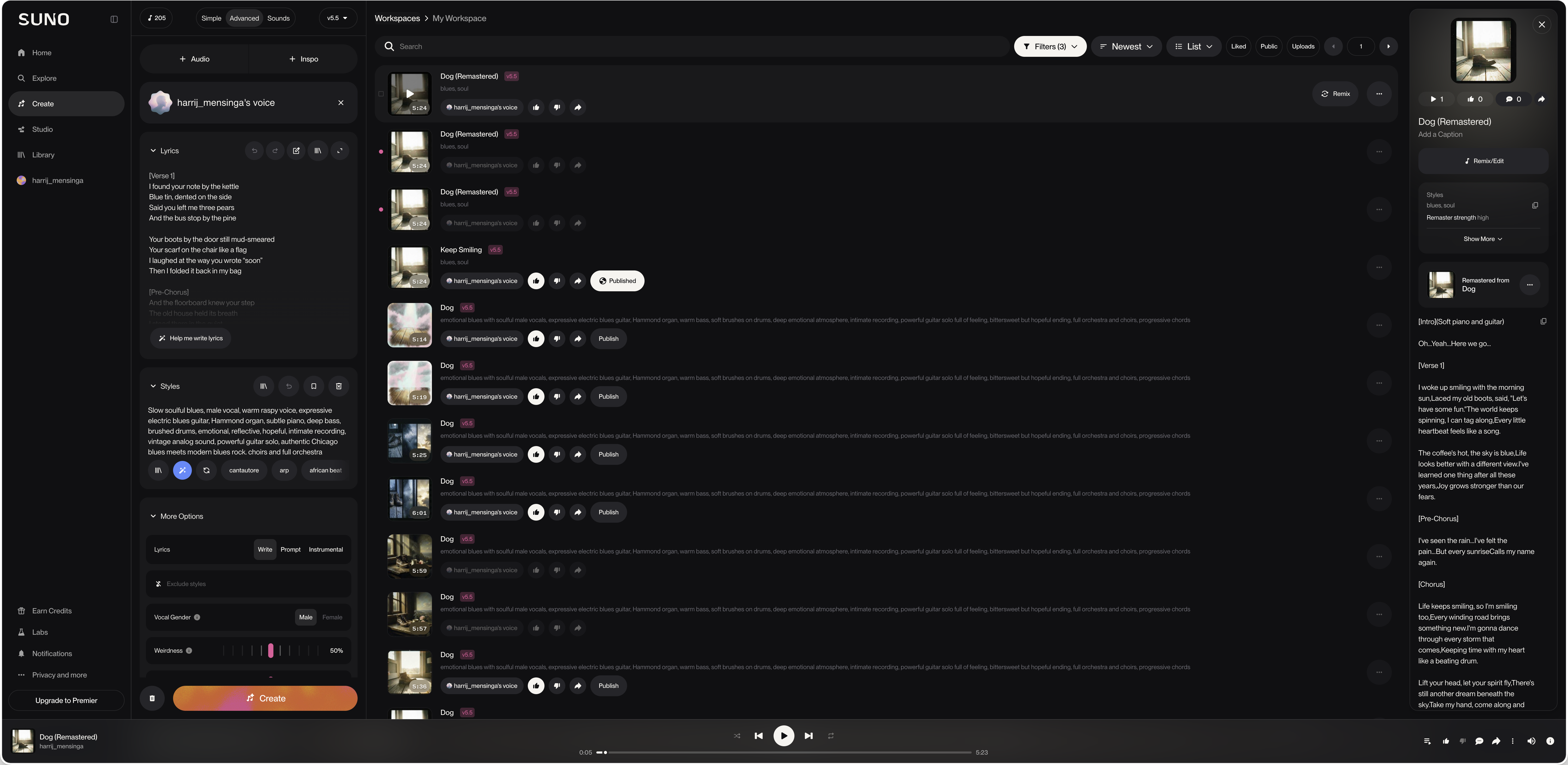
Someone with no musical background can generate a complete song in less than a minute.
| Strenght | Benefit | Details |
| Accessibility & Ease of Use | Creates complete songs with minimal expertise | Someone with no musical background can generate a complete song in less than a minute. Suno removes the need for music theory knowledge, songwriting skills, recording equipment, DAW software, and mixing expertise. |
| High-Quality Vocals | Natural and convincing singing | Unlike many AI music platforms, Suno produces vocals that often sound natural and emotionally engaging. Casual listeners may find it difficult to distinguish AI-generated vocals from human recordings. |
| Creativity & Experimentation | Enables rapid exploration of unique ideas | Users can easily experiment with unconventional genres and concepts such as medieval metal, cyberpunk opera, jazz rap, AI-generated movie soundtracks, and personalized birthday songs. The speed of experimentation is unprecedented compared to traditional music production. |
Where Suno Still Falls Short
Despite its impressive capabilities, Suno is far from perfect.
| Area | Issue | Details |
| Artistic Control | Limited control over production elements | Professional musicians often want precise control of individual instruments, arrangement details, vocal delivery, and song dynamics. Suno functions more like a collaborator, making many of the final creative decisions. AI vocal mistakes may also occur at the start of sung lines based on custom lyrics. |
| Repetition & Predictability | Recurring musical patterns | After extensive use, listeners may notice familiar chord structures, vocal styles, and song arrangements appearing across different generations. This reflects a common limitation of current generative AI systems. |
| Lyrics Quality | Lyrics can feel generic | Although lyric generation has improved, outputs can still be formulaic, repetitive, or clichéd. Human songwriters generally remain stronger at nuanced storytelling and conveying emotional depth. |
Authentic Human Emotion
The biggest limitation may be emotional authenticity. While Suno can imitate emotional expression remarkably well, it does not experience heartbreak, joy, struggle, love, or loss.
“Great music often comes from lived experiences, and AI currently lacks that human perspective”
Final Verdict and link to my personal Songs on Spotify
Rating: 8.5/10
| Plan | Price | Credits | Downloads / Month | Commercial Use | |
|---|---|---|---|---|---|
| Free | $0 | 50 credits daily | Not included | ❌ No | |
| Pro | $10/month ($8 annual) | 2,500 monthly credits | 20 per month | ✅ Yes | |
| Premier | $30/month ($24 annual) | 10,000 monthly credits | 60 per month | ✅ Yes | [suno.com] |
Bottom line: Suno represents a major shift in music creation as Suno AI is currently one of the most impressive consumer-facing AI music generators available. While it cannot replace the creativity, emotion, and artistic vision of great musicians, it demonstrates how far generative AI has advanced and offers an exciting glimpse into the future of music creation. Still it has limitations when using your own voice.