AI in Industry
 Harrij Mensinga8 min read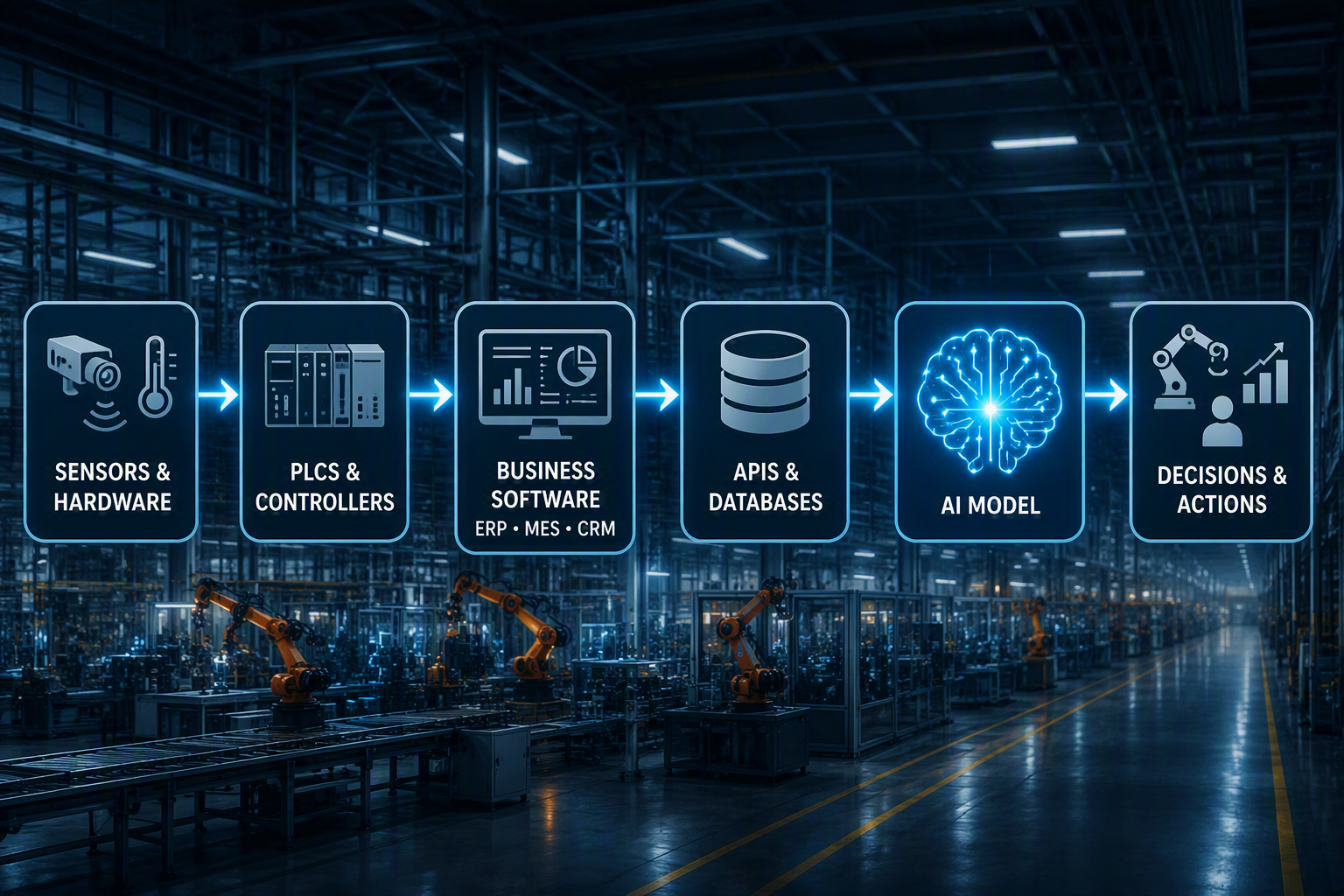
AI in Industry: Opportunity, Dependency and the Hidden Cost of Intelligence
Artificial intelligence is rapidly finding its way into factories, offices and production environments. The reasons are understandable. If AI can predict equipment failures, improve quality, analyse enormous amounts of production data and help people make better decisions, there is an obvious business case for using it.
But perhaps companies are asking the easiest question first.
What can AI do for us? There is another question that may become considerably more important once the first impressive demonstration is over:
What do we need to give up, build and maintain to make it work? AI is frequently presented as another software revolution. Install the technology, connect the data and productivity improves. Industrial environments don’t normally work quite that neatly. Factories contain equipment installed over decades, different automation systems, specialist software, old databases and, perhaps most importantly, enormous amounts of knowledge that may never have been properly documented at all.
AI can be extraordinarily capable. It still has to understand the environment in which we expect it to work.
The real value of industrial AI may depend less on what the AI already knows and more on what the company can teach it about itself.
AI doesn’t automatically know your factory
A general AI model can already know a surprising amount about engineering, manufacturing, maintenance and industrial processes. What it doesn’t automatically know is why your factory behaves the way it does.
Two plants producing essentially the same product can have different equipment, maintenance histories, operating limits, raw materials and procedures. Experienced operators also accumulate knowledge that is difficult to find in any database. They know that a particular pump begins to sound slightly different before a problem occurs, that one process becomes unstable under a certain combination of conditions or that a theoretically correct procedure doesn’t always produce the best result on a thirty-year-old installation.
That knowledge has been accumulated over years. For AI to become genuinely useful, it needs context. Production histories, sensor data, maintenance records, quality information, operating procedures and process relationships may all become part of that picture. And that leads to an interesting conclusion. Companies may discover that the most valuable part of an industrial AI project isn’t initially the AI at all.
It is their own data and accumulated knowledge.
AI simply makes it possible to use more of it.
Then the consultants arrive
There is another side to implementation that receives rather less attention in demonstrations.
Industrial AI isn’t just an AI model. Somebody has to connect it to databases and production systems. Somebody needs to understand the network, cybersecurity, industrial automation and the software already running inside the company. Data has to be cleaned, interfaces maintained and access rights controlled. For a large organisation with substantial internal IT and engineering departments this may be manageable. For smaller and medium-sized businesses it can quickly become a specialist project. External expertise isn’t a problem in itself. Companies have always used suppliers and consultants. The more interesting question comes six months or three years later. The business changes. A production line is modified. New equipment arrives. A supplier changes its software. Management wants the AI system to perform something nobody considered when it was originally implemented.
Who changes it?
If every significant modification requires the original specialist, cloud provider, integrator or consultant to return, the company hasn’t simply purchased new technology. It may also have purchased a new dependency.
That doesn’t make the investment wrong, but the dependency should be part of the investment decision.
Who actually owns the intelligence?
Data ownership makes this even more interesting. A manufacturer may have decades of production information. On paper it is simply data: temperatures, pressures, failures, maintenance activities, laboratory results and thousands of other measurements. In reality, that database may contain a considerable part of the company’s accumulated operational experience. Once AI begins analysing that information, companies have to decide where processing takes place and who is allowed access to it. Some applications can operate within company-controlled infrastructure, others use private cloud environments and many depend partly on external platforms and services.
The question isn’t simply whether cloud computing is safe or unsafe. That is too simplistic. Major cloud environments can provide security capabilities that many individual companies could never economically build themselves.
The more useful question is where control ultimately sits.
Can the company move its data and AI application elsewhere? Is it dependent on proprietary interfaces or model technology? What happens to historical information if the supplier relationship ends? Can the provider use submitted information for another purpose? And does the organisation actually know which information is leaving its own environment?
These are contractual and architectural questions as much as technical ones.
A company can own its data and still become dependent on somebody else’s technology to understand it.
AI isn’t floating somewhere in a cloud
The word cloud has always been slightly misleading. It sounds almost weightless.
There is nothing weightless about AI infrastructure.
Behind large AI services are physical data centres containing processors, storage, networking equipment, backup systems and substantial cooling and electrical infrastructure. As models and their use grow, so does demand for computing capacity. That doesn’t mean every industrial AI application requires a new data centre. Many industrial applications can use smaller specialised models, edge computing or existing cloud infrastructure. It would therefore be wrong to attach the enormous energy consumption of training frontier AI models to every predictive-maintenance application running in a factory.
But the wider infrastructure question remains legitimate. AI promises efficiency while simultaneously requiring considerable computing resources to provide it. The proper comparison therefore isn’t simply “AI consumes a lot of electricity.” We should ask whether the energy, hardware and infrastructure consumed by the AI produce greater savings or value elsewhere.
If an AI system uses computing resources but prevents major equipment failures, reduces waste and lowers the energy consumption of an industrial process, the balance may be strongly positive.
If we use an enormous model and infrastructure to solve a problem that could have been handled by conventional software, perhaps it isn’t.
Not every problem needs AI simply because AI is available.
The business case is bigger than the AI case
None of this is an argument against industrial AI.
Predictive maintenance alone can have enormous value when an unexpected equipment failure can stop an entire production process. Computer vision can improve quality inspection. AI can find relationships in large datasets that would be extremely difficult for people to recognise manually, while knowledge systems may help preserve experience that would otherwise disappear when experienced employees leave.
The possibilities are real. But so are the costs and dependencies. A serious business case should therefore contain more than the price of an AI licence and an estimate of productivity improvement. It should include integration, data preparation, security, infrastructure, maintenance, specialist knowledge, future modifications and the cost of changing supplier if that ever becomes necessary. We already learned this lesson with enterprise software and cloud computing. Changing technology can be relatively easy. Escaping from an architecture around which an entire organisation has gradually been built can be much harder.
AI could make that dependency even deeper because it doesn’t merely store company information. It may increasingly become part of how the company interprets that information.
What happens to the people who know why?
There is one more risk that I think deserves considerably more attention. Suppose an industrial AI becomes extremely good. For years it advises operators, identifies problems and recommends the correct response. Gradually people learn to trust it because, most of the time, it is right.
That sounds like success. But what happens to the underlying human knowledge?
If experienced engineers retire and younger employees increasingly rely on the AI rather than learning why a process behaves as it does, part of the company’s expertise may slowly migrate from people into a system they don’t completely understand. Then imagine the AI is unavailable, the supplier disappears or the system encounters a situation that wasn’t represented properly in its historical information.
Who is left who understands the process well enough to challenge it?
This isn’t a new problem. Automation has been changing human skills for decades. AI can simply take the development considerably further because it begins to automate parts of analysis and decision-making that previously remained with experienced people. The best industrial AI implementation may therefore not be the one that removes people from the process as quickly as possible. It may be the one that makes people better at understanding the process while keeping enough knowledge inside the organisation to recognise when the AI is wrong.
Control may become the real measure of success
The discussion around industrial AI tends to concentrate on capability: better prediction, faster analysis, lower costs and greater productivity.
All of those matter.
But I think companies will increasingly add another set of questions. Who maintains the system? Who controls the data? Can we change supplier? What happens when the AI is wrong? Do our own people still understand the process? And how much computing infrastructure are we prepared to depend on?
Those questions don’t make AI less attractive.
They make the decision to use it more mature.
Industrial AI has the potential to become one of the most important productivity technologies of the coming decades. But the smartest implementation may not be the one using the largest model or automating the greatest number of decisions.
The smartest company may ultimately be the one that gains the advantages of AI without giving away the knowledge, independence and control that made the company valuable in the first place.