Quantum Computing
 Written byHarrij Mensinga
18 min read
Written byHarrij Mensinga
18 min read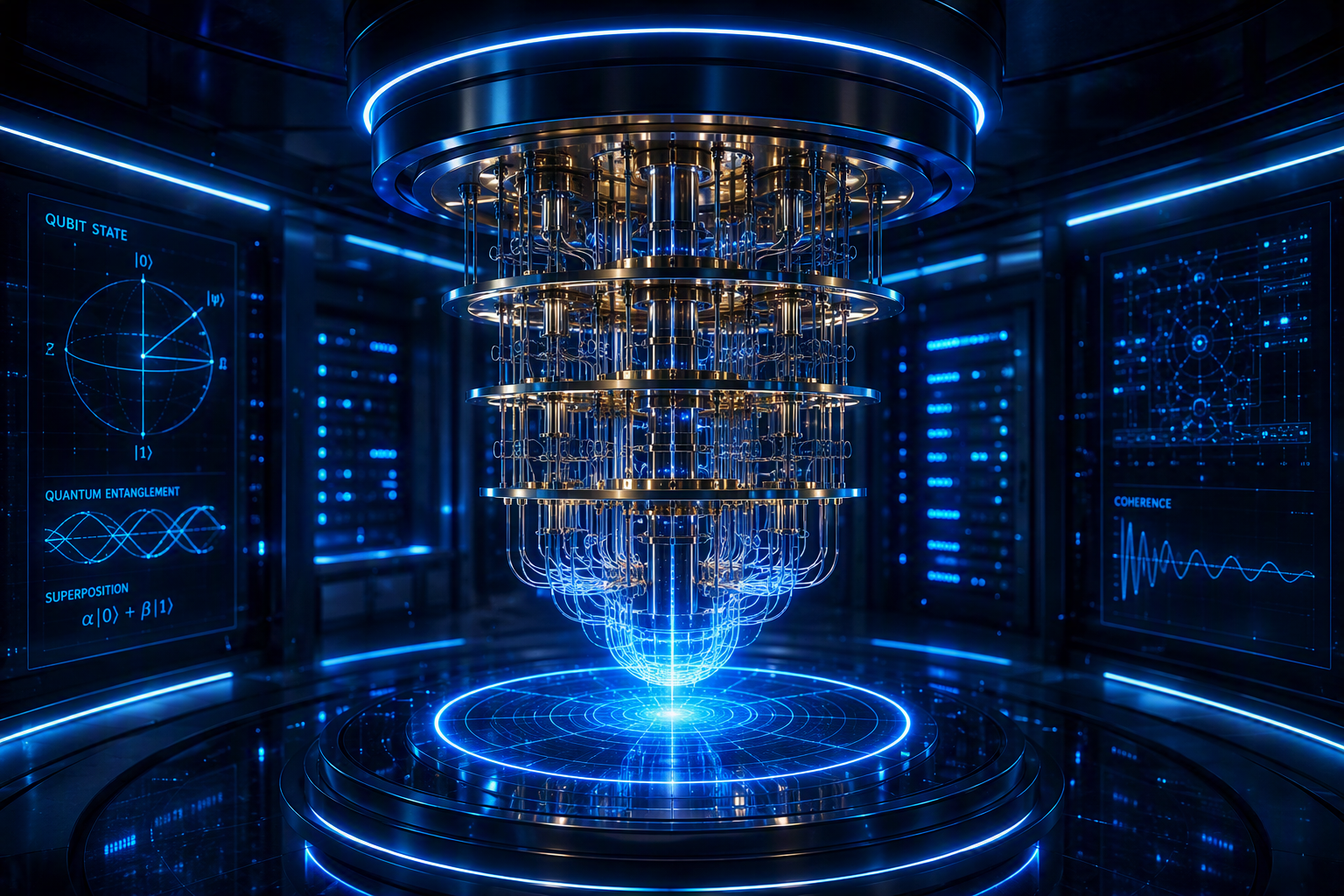
Quantum computers harness the power of quantum mechanics to perform computations that would be incredibly difficult, if not impossible, for classical computers to execute in a reasonable amount of time. However, building and maintaining a stable quantum computer is still a significant challenge, with issues such as decoherence and error correction needing to be solved before they can be widely applied.
Quantum computing is often explained through concepts such as superposition, entanglement and quantum interference. Those principles are essential, but they explain only part of the story.
A quantum computer is also a remarkable piece of engineering. Quantum states have to be created physically, controlled with extraordinary precision, protected from their environment, measured, and — perhaps most importantly — prevented from being overwhelmed by errors.
This is where many explanations of quantum computing become misleading. A qubit is sometimes described as simply being “0 and 1 at the same time,” while a quantum computer is said to “try every possible answer simultaneously.” These descriptions are useful as a first introduction, but they can give the wrong impression of what the machine actually does.
A quantum computer does not calculate every possible answer and then simply pick the correct one. Instead, it manipulates quantum probability amplitudes and their phases. A successful quantum algorithm is designed so that interference suppresses unwanted outcomes and increases the probability of measuring useful ones.
To understand quantum computing properly, we therefore have to connect three worlds:
quantum physics, computer science and physical engineering.
1. From Classical Bits to Quantum Bits
Every conventional computer ultimately works with bits.
A classical bit can have one of two states:
0 or 1.
Billions of transistors switch between these states to perform calculations, store information and execute software. A quantum computer uses quantum bits, or qubits.A qubit also has two computational basis states, conventionally written as:
|0⟩ and |1⟩
However, before measurement, a qubit can exist in a quantum state that is a combination of these basis states:|ψ⟩ = α|0⟩ + β|1⟩
Here, α and β are generally complex probability amplitudes. They contain both magnitude and phase information.
The probabilities of obtaining 0 or 1 when the qubit is measured are:
P(0) = |α|²
and
P(1) = |β|²with:
|α|² + |β|² = 1
The phase information contained in these amplitudes is extremely important because it allows quantum states to interfere with one another. That interference is one of the foundations of quantum algorithms.
2. Superposition — More Than “0 and 1 at the Same Time”
Superposition is perhaps the most famous concept in quantum computing. A qubit does not necessarily have to be entirely in state |0⟩ or entirely in state |1⟩. It can exist in a combination of the two.
For example:
1/√2(|0⟩ + |1⟩) represents an equal superposition. If we repeatedly prepare and measure this state, approximately half of the measurements will produce 0 and half will produce 1.
With two qubits, the system can have amplitudes associated with four computational basis states:
|00⟩, |01⟩, |10⟩ and |11⟩
With three qubits there are eight.
With n qubits there are: 2ⁿ basis states.
This exponential growth is important, but it leads to one of the most common misconceptions about quantum computing. It is often said that a quantum computer can therefore “calculate all possible answers simultaneously.” That is not quite correct.
Although the quantum state can contain amplitudes associated with an enormous number of basis states, measuring the system does not reveal all of those amplitudes. A measurement produces a classical result. The challenge for a quantum algorithm is therefore to manipulate the amplitudes before measurement so that useful answers become more likely to appear.
Superposition provides the mathematical space.
Interference determines how that space becomes computationally useful.
3. Entanglement — Qubits That Cannot Be Described Independently
Another essential property of quantum systems is entanglement. Two or more qubits can become correlated in such a way that their complete quantum state cannot be described simply by assigning an independent state to each qubit.
A well-known example is the Bell state:
1/√2(|00⟩ + |11⟩)
If the two qubits are measured in the computational basis, the results are correlated: when one produces 0, the other will also produce 0; when one produces 1, the other will produce 1. Entanglement remains one of the strangest consequences of quantum mechanics. However, the popular description that measuring one particle “instantly sends information” to another is misleading. Entangled particles can display correlations that cannot be reproduced by ordinary classical models, even when separated by great distances. But entanglement cannot be used to transmit usable information faster than light.
For quantum computing, the important point is that entanglement allows information to be represented in correlations across multiple qubits rather than only in individual qubits. Quantum algorithms exploit these collective states.
4. Quantum Gates — Programming the Quantum State
Classical computers perform operations using logic gates such as AND, OR and NOT.
Quantum computers use quantum gates. A quantum gate performs a controlled transformation of the quantum state. Mathematically, quantum gates are represented by unitary operations. Several gates appear frequently in quantum circuits.
The Hadamard gate (H) can create a superposition. Applied to |0⟩ it produces:
1/√2(|0⟩ + |1⟩)
- The Pauli-X gate behaves somewhat like a quantum NOT operation, exchanging |0⟩ and |1⟩.
- The Pauli-Y and Pauli-Z gates perform other rotations and phase transformations.
The CNOT gate operates on two qubits. Depending on the state of a control qubit, it changes a target qubit. Together with single-qubit operations, gates such as CNOT can be used to generate entanglement.
The Toffoli gate is a three-qubit controlled operation and is particularly important in reversible computation and some quantum circuit constructions.
But there is an important physical question hiding behind all of this mathematics:
- What does “applying a quantum gate” actually mean inside the machine?
5. A Qubit Is a Physical Object
A qubit is not merely a mathematical symbol floating somewhere inside a computer. It must be implemented using a physical quantum system.
Researchers have developed several approaches, including:
- superconducting electrical circuits;
- trapped ions;
- neutral atoms;
- photons;
- semiconductor spin qubits;
- and other experimental quantum systems.
These technologies behave differently and have different requirements.
Some quantum computers operate using individual atoms held by electromagnetic fields. Others manipulate ions using lasers. Photonic systems encode quantum information in particles of light.
One of the most developed approaches, used by companies including Google and IBM, is based on superconducting qubits. Here, tiny electrical circuits fabricated on a chip are engineered so that, under the correct conditions, particular energy states can function as the |0⟩ and |1⟩ states of a qubit. A crucial component in many superconducting qubits is the Josephson junction, which introduces the nonlinear electrical behaviour necessary to create controllable quantum energy levels.
The quantum processor itself can therefore be surprisingly small. The enormous structure surrounding it exists largely because keeping those tiny circuits quantum-mechanically useful is extremely difficult.
6. Why Superconducting Quantum Computers Are Almost at Absolute Zero
Quantum states are extraordinarily sensitive to their environment. At room temperature, matter contains considerable thermal energy. Atoms vibrate, electrons interact and electromagnetic radiation is constantly present. For ordinary computers this is generally manageable. For a quantum processor it can destroy the information being processed.
Superconducting quantum processors therefore operate at extraordinarily low temperatures, often around:
10–20 millikelvin
or only a tiny fraction of a degree above absolute zero.
Absolute zero is:
0 kelvin, or −273.15°C.
At approximately 15 millikelvin, the processor is therefore operating at roughly:
−273.135°C.
The objective is not simply to stop the processor from overheating. The purpose is to suppress thermal excitations and create the conditions in which superconductivity and delicate quantum states can be controlled with sufficiently low noise.
7. The “Golden Chandelier” Is Mostly a Refrigerator
Pictures of quantum computers can create another misconception. The large gold-coloured structure hanging inside the machine is sometimes assumed to be the quantum computer itself. Most of it is actually a highly sophisticated dilution refrigerator and its associated wiring, shielding and thermal stages.
The refrigerator contains multiple temperature levels. The upper parts are relatively warm. As we move downward through the machine, successive stages become colder. At the bottom is the mixing chamber and the coldest environment, where the quantum processor is normally installed in superconducting systems. Hundreds of cables may run through the machine. These cables have to carry signals from room-temperature electronics to the quantum chip while preventing excessive heat and electromagnetic noise from reaching the processor. Engineers therefore use attenuators, filters, shielding, amplifiers and carefully selected materials throughout the system.
The result is one of the strangest computers ever built:
a tiny quantum chip surrounded by a machine many thousands of times larger whose job is largely to protect and control it.
8. How Software Becomes a Physical Quantum Operation
Suppose a quantum program contains the instruction:
Apply a Hadamard gate to qubit 4.
There is no microscopic component labelled “Hadamard” that physically opens or closes. The instruction begins in a conventional computer. Software compiles the quantum algorithm into operations supported by the particular quantum processor. Specialized control electronics then generate precisely shaped signals.
In superconducting quantum computers these are commonly microwave pulses with carefully controlled:
- frequency;
- amplitude;
- phase;
- duration;
- and timing.
The pulse travels down the wiring inside the dilution refrigerator and reaches the appropriate part of the quantum processor. The electromagnetic field interacts with the qubit and changes its quantum state.
In simplified form:
Algorithm → quantum compiler → classical control electronics → microwave pulse → physical qubit → changed quantum state
A mathematical quantum gate is therefore translated into a physical event. That event may last only nanoseconds. If the pulse is slightly too long, too short, too strong or at the wrong frequency or phase, the gate may not perform exactly the intended transformation. That introduces an error.
9. Quantum Interference — Where Much of the Computational Power Comes From
Imagine two waves meeting.
- If their peaks align, they reinforce one another.
- If a peak meets a trough, they can cancel.
Quantum probability amplitudes also interfere. This allows quantum algorithms to manipulate not only the probabilities associated with states but also their phases. A well-designed quantum algorithm creates a sequence of operations in which amplitudes associated with unwanted outcomes tend to cancel while amplitudes associated with useful outcomes are reinforced. This is why the statement that a quantum computer simply “tries every answer simultaneously” is incomplete.
The important process is:
prepare → transform → entangle → interfere → measure.
The algorithm engineers the interference pattern. That is where much of the advantage comes from.
10. Measuring the Quantum Computer
Eventually, the quantum information has to become ordinary information again. Measurement converts the quantum state into classical data.
For a qubit described by:
|ψ⟩ = α|0⟩ + β|1⟩
measurement in the computational basis produces 0 with probability |α|² and 1 with probability |β|².
After that measurement, the original superposition is no longer available in the same form. In superconducting quantum computers, qubits are commonly coupled to microwave resonators. The state of a qubit affects the electromagnetic response of its associated readout system. A microwave signal can therefore be sent through the resonator, and changes in the returning signal reveal information about the qubit state. That tiny signal has to be amplified and processed by conventional electronics.
The result ultimately becomes an ordinary:
0 or 1
that a classical computer can process.
11. Why Quantum Calculations Are Usually Repeated
A quantum computer does not necessarily run an algorithm once and announce:
“The answer is 42.”
Quantum measurement is probabilistic. The same circuit is therefore commonly executed repeatedly. Individual executions are often called shots.
Suppose repeated measurements produce:
| Result | Measurements |
|---|---|
| 00 | 517 |
| 01 | 31 |
| 10 | 42 |
| 11 | 9,410 |
The classical computer can analyse this distribution and conclude that 11 is overwhelmingly the dominant result. This statistical behaviour is a normal part of quantum computation. But it is important to distinguish this from actual hardware errors.
- Quantum probability is expected.
Hardware errors are unwanted.
They are not the same phenomenon.
12. Why Quantum Computers Make So Many Errors
Modern classical computers are extraordinarily reliable. Quantum computers are not.
A qubit can be disturbed by many factors:
- thermal energy, electromagnetic radiation, microscopic material defects, neighbouring qubits, imperfect control signals, vibrations, measurement imperfections and interactions with the surrounding environment.
Several different errors can occur.
A bit-flip error can effectively change |0⟩ into |1⟩.
A phase-flip error alters the phase of the quantum state.
There can also be gate errors, readout errors, leakage into unwanted energy levels and correlated errors affecting multiple qubits.
Another major problem is decoherence.
13. Decoherence — When the Quantum State Leaks Into the Environment
A useful quantum state must remain coherent. But no physical qubit is perfectly isolated.
Eventually the quantum system interacts with its environment. Information about the quantum state effectively leaks into that environment and the carefully controlled phase relationships required for quantum computation deteriorate. This is decoherence. Two important measurements of qubit quality are often called T1 and T2 times.
- T1 roughly describes how long an excited qubit retains its energy before relaxing.
T2 describes how long useful phase coherence can be maintained.
The quantum gates have to be performed sufficiently accurately and quickly relative to these times.
This produces an engineering race against the clock. The quantum computer has only a limited window in which to perform useful operations before noise overwhelms the quantum information.
14. Why Not Simply Copy the Qubit?
Classical computers solve many reliability problems through redundancy. If information is important, make another copy. Quantum mechanics makes this much more difficult. An arbitrary unknown quantum state cannot simply be copied perfectly because of the no-cloning theorem. There is another complication. Directly measuring a qubit generally disturbs the quantum state we are trying to preserve. So quantum error correction faces an apparently impossible task:
detect an error without simply reading and destroying the information being prote
Quantum error correction solves this using one of the most ingenious ideas in quantum information science.
15. Quantum Error Correction
Instead of storing quantum information in one physical qubit, the information can be encoded across multiple physical qubits.
The group collectively represents a more reliable:
logical qubit.
Additional measurements are performed to detect particular relationships between the physical qubits. These are known as syndrome measurements. The important point is that the system can learn something about the error without directly learning the encoded quantum information itself. For example, the syndrome may indicate: “Something consistent with a bit-flip error occurred in this region.”
A classical computer then analyses the syndrome information and determines how the logical state should be interpreted or corrected. This process is repeated continuously during a fault-tolerant quantum computation.
Quantum error correction is therefore itself a hybrid process:
quantum hardware generates error information, while classical computers help interpret and respond to it.
16. Physical Qubits Versus Logical Qubits
This distinction is essential when reading announcements about quantum computers.
- A physical qubit is an actual quantum device on the chip.
A logical qubit is protected quantum information encoded across a collection of physical qubits.
The number of physical qubits required for one high-quality logical qubit depends on many factors:
- physical error rates;
- the error-correction code;
- chip connectivity;
- the type of errors;
- required computation length;
- and the reliability demanded by the algorithm.
For demanding future applications, one logical qubit could require hundreds or potentially thousands of physical qubits. The exact number is not universal.
That is why comparing quantum computers simply by asking:
“How many qubits does it have?”
can be misleading. A more meaningful question is:
How many useful logical qubits can the machine operate, at what logical error rate, and for how long?
17. Surface Codes and the Error Threshold
One of the most widely researched quantum error-correction approaches is the surface code. Physical qubits are arranged so that repeated measurements can detect patterns indicating quantum errors. The surface code is attractive partly because it can tolerate comparatively realistic physical error rates and uses primarily local interactions between neighbouring qubits.
An important concept here is the error threshold.
If the physical error rate is too high, adding more error-correction machinery does not solve the problem. But if physical operations become sufficiently reliable and fall below the relevant threshold, increasing the strength of the error-correcting code can reduce the logical error rate.
This changes the engineering objective. Scientists do not necessarily need to invent perfectly error-free physical qubits. Instead, they need physical qubits and gates that are good enough for quantum error correction to suppress errors faster than the system creates them. That is a crucial step toward fault-tolerant quantum computing.
18. Why Error Correction Requires So Much Hardware
Quantum error correction comes at a substantial cost. Suppose a useful future quantum algorithm requires thousands of reliable logical qubits. If each logical qubit requires hundreds or thousands of physical qubits, the physical processor could eventually require millions of qubits.
Those qubits must also be:
- controlled, connected, cooled, calibrated and measured.
- The machine needs enormous amounts of supporting infrastructure.
This is why quantum computing is not merely a semiconductor scaling problem similar to the historical development of classical microprocessors. Adding qubits without maintaining their quality can actually make the engineering problem harder. A million poor qubits are not automatically more useful than a thousand excellent ones.
19. Quantum Speedup — Powerful, but Not for Everything
Another misconception is that quantum computers will make every computer program faster. They will not. Quantum computers are expected to provide major advantages only for particular classes of problems where quantum algorithms can exploit the structure of the problem. One famous example is Shor’s algorithm, which can factor sufficiently large integers dramatically more efficiently than known classical methods when executed on a sufficiently large fault-tolerant quantum computer. This matters because widely used public-key cryptographic systems such as RSA rely on the practical difficulty of factoring large numbers. Another example is Grover’s algorithm, which provides a quadratic speedup for certain unstructured search problems.
Quantum simulation may ultimately be even more important. Nature itself behaves quantum mechanically. Simulating molecules, materials and chemical reactions on classical computers becomes extremely difficult as quantum complexity increases.
Quantum computers could eventually help investigate:
- new medicines;
- catalysts;
- battery chemistry;
- superconducting materials;
- molecular behaviour;
- complex physical systems.
Optimization and machine learning are also major research areas, although claims of dramatic quantum advantages in these fields should be treated carefully. Not every theoretical quantum algorithm will necessarily provide a useful real-world advantage once hardware limitations and classical alternatives are considered.
20. The Quantum Computer Does Not Replace the Classical Computer
Perhaps the most useful way to understand a future quantum computer is not as a replacement for today’s computers but as a specialized quantum accelerator.
A practical quantum system contains several layers.
Classical software defines the problem.
A quantum compiler converts the algorithm into instructions suitable for a particular quantum processor.
Classical control electronics generate precisely timed microwave, electrical or optical signals.
Cryogenic or other environmental systems protect the quantum hardware.
The quantum processor performs the quantum transformations.
Measurement systems extract information from the qubits.
Classical computers process measurements, decode error syndromes and analyse the final result.
The quantum and classical machines therefore cooperate. In many future applications, most of the program may still execute on conventional computers. Only the part of the problem that benefits from quantum computation would be sent to the quantum processor. This is conceptually similar to the way GPUs today accelerate particular workloads without replacing the CPU.
21. Not Every Quantum Computer Needs Extreme Refrigeration
The famous near-absolute-zero refrigerators are strongly associated with superconducting quantum computers. But it would be incorrect to conclude that all quantum computers must operate at 10 millikelvin. Different qubit technologies have different environmental requirements. Trapped-ion quantum computers use electrically charged atoms held in electromagnetic traps and manipulated with lasers.
Neutral-atom systems use lasers to trap and control individual atoms. Photonic quantum computers manipulate particles of light. Semiconductor spin qubits can require cryogenic environments but may operate under different conditions from superconducting processors.
Each approach has advantages and disadvantages involving:
- coherence;
- gate speed;
- error rates;
- connectivity;
- manufacturing;
- cooling;
- control complexity;
- and scalability.
It is therefore still uncertain which physical technology — or combination of technologies — will dominate large-scale quantum computing.
22. Why Cooling and Error Correction Solve Different Parts of the Same Problem
Cooling, shielding and error correction are closely connected.
Cooling reduces thermal disturbances.
Electromagnetic shielding reduces external noise.
Improved materials reduce microscopic defects.
Better manufacturing makes qubits more consistent.
Improved pulse control increases gate accuracy.
Better calibration reduces systematic errors.
Quantum error correction deals with the errors that still remain.
The objective is therefore not to eliminate one single problem.
It is to improve the entire quantum computing stack until useful computations can survive long enough to finish.
23. The Real Measure of Progress
Quantum computing headlines often focus on qubit numbers:
127 qubits.
1,000 qubits.
10,000 qubits.
Those numbers are interesting, but by themselves they tell us surprisingly little.
A more serious evaluation should ask:
Are these physical or logical qubits?
What are the single- and two-qubit gate error rates?
How reliable is measurement?
How long do the qubits remain coherent?
How well connected are they?
Can error correction actually reduce the logical error rate?
How many operations can be performed before errors overwhelm the calculation?
Can the system scale without the cooling, wiring and control electronics becoming impractical?
These questions reveal the enormous difference between demonstrating quantum behaviour and building a genuinely useful quantum computer.
24. From Noisy Quantum Computers to Fault-Tolerant Machines
Most current quantum processors still operate in an era commonly associated with noisy quantum hardware. They can perform genuine quantum operations and are extremely valuable for research, but errors limit the depth and complexity of calculations that can be executed reliably. The long-term objective is a fault-tolerant quantum computer. Such a machine would use quantum error correction to maintain logical qubits with sufficiently low error rates that very long quantum algorithms could be executed reliably. That is the real technological threshold.
The breakthrough will not simply be:
“We built a processor with more qubits.”
It will be closer to:
“We can make logical quantum information increasingly reliable as we scale the error-correction system.”
That would demonstrate that quantum computing can move from fragile laboratory experiments toward dependable computation.
Conclusion: What a Quantum Computer Is Really Doing
A quantum computer begins with physical quantum systems that can represent qubits. Those qubits are prepared in carefully controlled states. Quantum gates manipulate their amplitudes and phases. Qubits become entangled.
Interference changes the probability distribution of possible outcomes. The system is measured. Classical electronics convert those measurements into ordinary information. The computation is often repeated many times to establish statistically meaningful results. Throughout the process, the hardware must fight decoherence, noise, imperfect gates and measurement errors. For superconducting quantum computers, this requires operating tiny processors only a fraction of a degree above absolute zero and controlling them using extremely precise microwave signals delivered through a sophisticated cryogenic system. And because physical qubits will never be perfectly reliable, quantum error correction attempts to combine many imperfect physical qubits into much more dependable logical qubits.
This reveals what may be the most important fact about quantum computing. The fundamental quantum mechanics is not the only challenge. We already know that superposition, entanglement and interference exist.
The extraordinary challenge is engineering a machine that can control those effects accurately enough, for long enough, and on a large enough scale to perform useful calculations.
That is why the future of quantum computing will not be decided simply by who has the largest number of qubits. It will be decided by who can turn fragile quantum physics into reliable logical computation.
And that may ultimately prove to be an engineering achievement every bit as remarkable as the quantum mechanics on which it is based.