Digital Workforce
 Written byHarrij Mensinga
8 min read
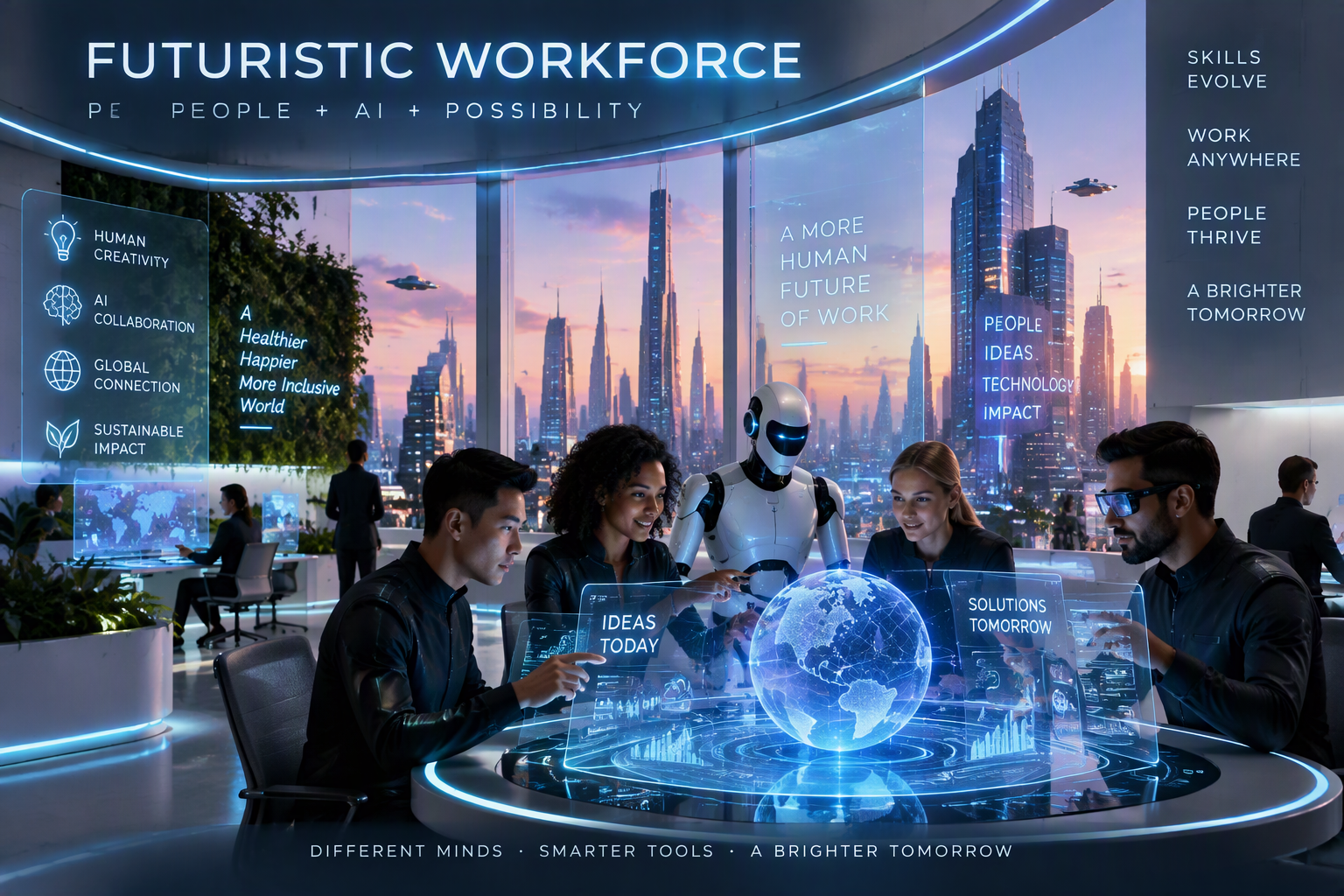
The Digital Workforce Reshaping 2026
For years, artificial intelligence mostly waited to be asked. It answered questions, generated text, summarized documents and assisted with clearly defined tasks. In 2026, that relationship is changing. AI is no longer confined to the role of a passive assistant. A new generation of autonomous agents can pursue goals, plan several steps ahead, operate software and adjust its approach when something goes wrong.
This may prove to be the defining technology shift of 2026—not because AI has suddenly become independent in the human sense, but because it can now participate in workflows instead of merely commenting on them.
The difference is profound. Traditional software follows predetermined instructions. Generative AI responds to prompts. An autonomous agent can decide which actions are necessary, select the appropriate tools and continue working until it reaches a result or encounters a limit requiring human judgment.
That brings us closer to a digital workforce—but also introduces new forms of risk, responsibility and organisational dependence.
From answering questions to completing work
An autonomous AI agent is a software system designed to accomplish a goal on behalf of a user or organisation. Depending on its permissions, it may be able to:
- interpret an objective;
- break it into smaller tasks;
- collect information from multiple sources;
- use browsers, databases, APIs and business applications;
- monitor the results of its actions;
- correct mistakes or change strategy;
- maintain context across a long-running assignment;
- request approval when it reaches a sensitive decision.
The important distinction is agency. A chatbot may explain how to process an invoice. An agent can retrieve the invoice, compare it with a purchase order, identify discrepancies, enter approved data into the accounting system and flag an exception for review.
That does not make the agent conscious, nor does it turn software into a legal employee. The “digital workforce” metaphor is useful because agents perform sequences of work. It becomes misleading when organisations assume that agents possess human judgment, accountability or common sense.
Why agents are emerging now
Three developments have made practical agents possible.
Better reasoning and context
Modern models can work with far larger amounts of information than earlier systems. An agent can examine extensive documentation, follow a project across many steps and preserve relevant context while it works.
Large context windows do not produce perfect memory. Important details can still be overlooked, misunderstood or displaced by irrelevant information. Nevertheless, the ability to process substantial bodies of material has made longer and more complicated workflows realistic.
Multimodal perception
Agents are increasingly able to interpret text, images, audio, video, interface elements and structured data. They can inspect a document, read a chart, analyse a screenshot and interact with software through its interface.
This matters because real work rarely exists in a single clean database. It is spread across emails, PDFs, spreadsheets, websites, meetings and specialised applications.
Tool use
The biggest leap may be the ability to act through tools. An agent can search the web, query a database, execute code, update a record or operate an application—provided it has been granted access.
OpenAI describes agents as systems that can manage workflows, make decisions and dynamically select tools within defined guardrails. Its own deployment guidance recommends starting incrementally rather than immediately attempting unrestricted autonomy. OpenAI’s practical guide to building agents.
The point is worth emphasising: the agent’s power comes not only from the model, but from the combination of intelligence, tools, access and permission.
What agents can already do
Agents are beginning to perform useful work in several fields.
In customer service, they can examine customer history, answer questions, initiate routine corrections and escalate exceptional cases.
In software development, agents can inspect repositories, write and test code, diagnose failures, prepare documentation and submit proposed changes for review.
In research and data analysis, they can gather information, clean datasets, compare sources, produce visualisations and draft reports.
In operational environments, they can help process invoices, reconcile records, monitor inventories and coordinate recurring administrative workflows.
These systems remain imperfect. They may misunderstand instructions, use the wrong source, repeat an unsuccessful action or confidently pursue a flawed assumption. But they can already reduce the amount of manual coordination required for many multi-step tasks.
Productivity without the mythology
The business case for agents is compelling. They can operate quickly, handle many routine tasks and continue long-running work without fatigue. They can also make processes more consistent and easier to audit when every step is recorded.
But claims that agents work “without human error” should be treated with suspicion. Agents do not eliminate errors; they change their nature.
A human employee may mistype a figure. An agent may apply a mistaken interpretation to thousands of records in minutes. A person may forget a procedure. An agent may follow the procedure perfectly even when the situation requires an exception.
The strongest implementations therefore do not simply remove people from a process. They redesign the division of labour:
- machines handle volume, retrieval and repeatable execution;
- people define goals, approve sensitive actions and judge exceptional situations;
- monitoring systems verify what both are doing.
The real productivity gain comes from reducing coordination costs while preserving human control where it matters.
The rise of new roles
Agents are unlikely to eliminate work in a simple one-for-one exchange. They will reorganise it.
Organisations increasingly need people who can:
- design agent workflows;
- define permissions and escalation rules;
- evaluate output quality;
- supervise automated operations;
- investigate failures;
- protect connected systems;
- and determine which decisions should never be delegated.
Roles such as AI workflow architect, agent supervisor, automation auditor and AI safety specialist will become more common. Existing managers will also need a new skill: managing work performed partly by people and partly by software.
Autonomy increases the consequences of failure
A language model that gives a poor answer creates an information problem. An agent with access to email, financial systems or production software can create an operational problem.
The major risks include:
- prompt injection through malicious documents or websites;
- disclosure of confidential information;
- actions performed with excessive permissions;
- propagation of inaccurate data;
- unauthorised transactions;
- weak or incomplete audit trails;
- and automation bias, in which people trust a system because it appears confident and efficient.
NIST concluded in 2026 that AI agents create novel security threats and that existing cybersecurity practices must be adapted for agentic systems. It has consequently launched an initiative focused on agent security, identity, authorisation and interoperability. NIST’s AI Agent Standards Initiative.
Zero-trust principles are therefore highly relevant, but saying that zero trust alone solves the problem would be too simple. Secure agent deployment also requires:
- least-privilege access;
- explicit approval thresholds;
- separation of duties;
- immutable activity logs;
- transaction limits;
- isolated execution environments;
- continuous evaluation;
- and a reliable method for stopping an agent.
The more irreversible an action is, the stronger the case for human approval.
Accountability cannot be delegated
When an autonomous agent makes a damaging decision, responsibility does not disappear into the software.
The organisation deploying the agent remains responsible for:
- selecting an appropriate system;
- determining what it may access;
- testing it before deployment;
- monitoring its behaviour;
- protecting affected customers and employees;
- and providing a meaningful route for correction and appeal.
“An AI agent did it” will not be an acceptable answer to a regulator, customer or court.
Transparency also needs to extend beyond an explanation generated after the event. Organisations require factual records showing:
- what information the agent received;
- which tools it used;
- which actions it performed;
- what approvals it obtained;
- and why a workflow was escalated or completed.
Multi-agent systems: promising, but not automatically better
The next step is already visible: teams of specialised agents.
One agent may conduct research, another analyse data, a third challenge the conclusions and a fourth assemble the final report. In theory, they can divide work, verify one another and complete projects that exceed the scope of a single system.
But adding agents also adds complexity. Errors can pass between them, responsibilities become less clear and the cost of observing the entire process increases. A group of agents can reproduce one another’s mistakes just as easily as it can correct them.
Multi-agent systems should therefore be used when specialisation genuinely improves the workflow—not because a digital committee sounds more advanced. In many cases, one well-designed agent with appropriate tools and safeguards will be more reliable.
The real transformation
Autonomous agents will not succeed because they imitate employees. They will succeed where organisations redesign work around their strengths and limitations.
The companies most likely to benefit will:
- begin with bounded, measurable workflows;
- preserve human approval for consequential actions;
- grant only the minimum necessary access;
- evaluate agents continuously;
- and expand autonomy only after reliability has been demonstrated.
Those that simply connect an agent to every business system in pursuit of rapid savings may discover that autonomous mistakes scale as efficiently as autonomous work.
Autonomous AI agents are becoming a meaningful new layer of digital operations. They can reason through ambiguity, use tools and carry multi-step assignments further than previous generations of software. That makes them potentially transformative.
But they are not infallible digital employees. They are powerful operational systems whose usefulness depends on careful design, limited authority and accountable human governance.
The defining competitive advantage of 2026 will not be having the most autonomous agents. It will be knowing precisely where autonomy creates value—and where it must stop.